eLoomanator

weaving on little looms

Square Deal Weave-Along #17—Color & Weave

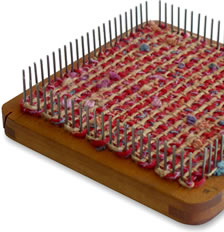
Red & white Check

If you’ve woven any of the Square Deal Weave-Along patterns in more than one color per sample, you know that you add visual complexity by simply changing colors at different points in the warping and weaving process. Even using two threads at the same time in two colors that are close in hue will add visual depth to the cloth. When you plan the arrangement of those two (or more) colors, it’s called Color and Weave. Plaids, checks, log cabin, and houndstooth are some common examples of Color and Weave.

We can wrap layers of yarn in different colors on Weave-It type looms—OR we can warp and weave with two colors at once—OR we can start with two colors and drop one out at intervals throughout the four layers. That’s how I wove the sample above. One strand of both red and white; drop the red; pick up the red when I got back to that side—all the way through, including the weaving step. Weaving this requires rethreading for each pass.

Another thought—you could do all of one color in a layer, then follow up with the second color separately, before turning the corner for the next layer. Definitely. I’m doing that next time.

check warp check weaving

For the red and white sample, I took care to always have the red to left or on top of the white. For the blue and white sample below, I just let them fall wherever…The result is that sometimes I got DLDL (dark light dark light), sometimes LDDL, sometimes LDLD, sometimes DLLD.

blue & white check

For the black and tan sample below, I wove with two strands of light weight wool at the same time, with some care in the wrapping, but not obsessing over it at all. I like it!

Black & Tan

The last square was wrapped with light and dark linen/cotton at the same time, then woven with a red hemp blend.

Three color

Square Deal Weave-Along #16—Triangles

Brown Triangles

What you’re looking at is not the center motif, but the four corners, each composed of two triangles. You don’t have a triangle loom? No bother—they can be woven with any square loom that you have on hand. While I wouldn’t want to make tons of triangles on a square loom, it gets easier with practice and neatly solves the problem of fill-in triangles for a bias design. Sarah at Knitting-and.com posted about this technique and then followed up with a photo of her seamed triangles that you’ll want to look at.

Triangles woven in this manner have straight grain on the long edge (hypotenuse). The two shorter sides have bias edges. You can make a loom-sized square with two triangles, or a larger square with four triangles. Triangles are essential when you’re creating a bias design and don’t want sawtooth edges. (I like sawtooth edges, but sometimes it just announces that you didn’t know what else to do.)

In addition to a square loom and weaving needle, you’ll need a thin knitting needle or piece of stiff wire that’s a bit longer than the diagonal measurement of your loom and a skinny crochet hook. Lay the needle or wire from one corner to the opposite corner. Small rubber bands anchored around the needle tip, around the frame and back to pins above the corner—on each side—keep it all together until you get the weaving started.

I’m not going to give you step-by-step instructions because there are a number of websites that already have done that, better than I can.
Workstead Fiber Studio
eBay guide: Learn to Weave on a triangle loom
Wayne Schmidt’s Triangle Loom page
The only difference is that you’ll have a needle across the long edge of the triangle, where these instructions all show nails. Yarn goes over the needle instead of over nails.

Several things to remember when weaving triangles on a Weave-It or Weavette:
• Grouped pins and spaces do not affect your weaving.
• You’re weaving on the bias now and the threads are set more closely, so if you’re using the same yarn that you used in regular squares, you’ll want to loosen up the sett by skipping some pins. (I skipped every 5th pin for the sample.)
• Remove the knitting needle or wire from long edge of triangle before removing the piece from the loom. Then use your needle to stroke threads toward the long edge, filling in the loops that went around the knitting needle. Get everything adjusted before you take the triangle off the loom.

This gets easier and faster and nicer looking with practice. My first two triangles were throw aways, but after that they looked decent and even had nice corners.

Triangle 1

Triangle 2

Triangle 3

Triangle 4

Bolsa

Bolsa

Handwoven Magazine is running a Bag of the Month series with a free PDF download of the pattern on their website. The March/April 2008 bag is called Patchwork Peg-Loom Bag, designed by Maria Cristina Capellotto of Sao Paulo, Brazil, and I couldn’t wait to make it.

Maria calls for a 10” square loom. The closest I had without getting too big was my Hazel Rose 7” loom. In retrospect, I wouldn’t want it any larger. The finished bag is 9.5″ square. The original bag was made of sisal, but any stiff yarn would work and I had the perfect candidate in mind:

Aloo Aloo detail
Himalayan Yarn Co. TIBET 100% Aloo

Aloo (nettle) is stiff and difficult to use. It can be brittle, overtwisted, slubby, wiry and just downright contrary. It takes a firm hand to tame this stuff. I’ve tried knitting it, crocheting it, and weaving with it on a Weavette—with varying degrees of success. Basically I’m at the point of wanting to use it up and get it out of my life. This pattern is a perfect vehicle.

Aloo bag weaving

The bag calls for five woven squares, assembled just so, lined, with a braided strap. It wasn’t difficult at all. The lining is supposed to be interfaced, but I didn’t do that and probably should have. Next bag. All but one of my squares was plain weave. The flap square is a twill. I added a linen yarn to that square. My strap is composed of various linens along with one strand of aloo.

Latched loops

lining

Weaving this made me appreciate my square Hazel Rose loom all the more. The latched loop seams were fun and I hope to revisit this idea (with another yarn!) soon.

Bolsa detail

bag back

Off the Grid—a 3D Weaving Challenge

All of the projects submitted for the first contest were three-dimensional (or displayed that way) This is certainly one of the strong suits of working with small pieces that can be easily manipulated. Let’s continue that theme with larger projects.

Perhaps the first thing that you ever thought of making with your handheld loom was a blanket or afghan. Assemble lots and LOTS of pieces, add a border and there you have it. Nothing wrong with that—I’ve done it and appreciate the ones that others have made, too.

But if flat pieces were the end of it, I would have abandoned these looms long ago. I’m always on the lookout for projects that take advantage of the four finished (albeit loopy) edges, the bias stretch, the pulled warp and the small size of Weave-It or Weavette pieces.

Your challenge is to create something three-dimensional with at least twelve or more pieces. Your creation should invite views from different angles. Make us want to hug it, crush it, wear it, play with it, turn it upside-down, or display it in an unexpected way. Feel completely free to marry the weaving to another fiber technique. But if we need to see it stretched out on a flat surface to appreciate the lovely design—save it for a different contest.

Two months will give you time to call upon your muse, but don’t drag your feet on getting started because there will be fabulous prizes and you don’t want to be doing this at the last minute.

PLEASE READ THE RULES

• Project made of twelve or MORE woven squares or rectangles. (No upper limit to number of pieces.) Pieces can be all one size or any combination of sizes.

• Pieces must be woven on a handheld loom.

• You are encouraged to incorporate other craft techniques (embroidery, knitting, crochet, beading, rubber stamping, etc.), but weaving must be an integral part of the project, not just an embellishment.

• Finishing counts. Complete the project, with all seaming done, ends woven in, etc.

• This is your ORIGINAL idea. That doesn’t mean that you cannot use another idea as inspiration, but I don’t want to see your project, with a few minor variations, already on the web.

• Give your project a name.

• Project photos and written directions (or photo tutorial, if that is more appropriate) are to be submitted to me by Wednesday, May 21. (Please send your best quality photos to me in a separate email. Up to 2 or 3MB is OK.) There will be outside judges this time, although I will weigh in, too. Winners will be announced on Wednesday, May 28th.

• Entrants grant me permission to post the project and instructions on this website first. After I post it, you can publish it wherever you wish.

3D prizes

The first fabulous prize is a Weave-It Rug Loom with original box, leaflet and needle. You all know this is my favorite loom in the whole world because I can weave funky stuff on it. And they’re pretty difficult to obtain. No one makes an exact reproduction (yet) and the prices on eBay can soar. So here’s your chance.

Honorable mention fabulous prize is a 2” Weave-It loom with original box, leaflet and needle, and my favorite folding scissors, all packed in a Hello Kitty lidded tin with room inside for a skein of yarn. Pack that in your purse.

Of course the real prize is that you will be famous to a small group of readers—for a few days at least—and will have the undying admiration of small loom weavers worldwide. And the knowledge that you’ve added to the repertoire of a wonderful fiber craft.

Next week I’ll be back with more Square Deal Weave-Along. It twill be interesting, so I hope you’re all caught up.

Lovely Heart Pincushion

heart pincushion

Almost everyone’s first introduction to weaving was a potholder loom on which they wove stretchy loops to make a potholder for Mom. Most left it at that, having learned how to take skinny strings and turn them into solid fabric with simple interlacement. Today, when you mention handheld looms to the uninitiated, they often respond with a snort or a smirk. (YOU know!) They are remembering the childish play and the rather primitive-looking product and maybe mom used it for awhile and then let it go the bottom of the linen drawer. That’s too bad for them, because potholder looms are great tools, but that’s not really what this is about. It’s about exposing children to crafts, weaving in particular, at a young age.

My 17-month-old grandson’s favorite toy at Nana’s house is the basket of Weave-It samples. He flings them, rolls in them, examines them carefully, puts them in a bag and pulls them out, drops them on the dogs, picks out his favorites and carries them around all day. They end up in his pockets and hoods and under every piece of furniture. The angora ones have been felted to tiny squares from his fondling them. This kid is into textiles. I can’t wait to teach him how to weave and knit and dye and spin and felt.

I don’t know how soon I can get a loom in his hands and what kind it will be. A friend of mine has a Brio table loom for her grandsons, which she warped and they get to weave and beat in the weft. That sounds like a good start. It would take more coordination to handle a potholder loom and more than that for a Weave-It or Weavette. Please post your weaving-with-child reports in the comments because I, for one, am interested in hearing them.

All of this is leading up to our last, but NOT least, Six Square Smackdown project, woven by Princess Peach of Sydney, Australia. She was ten years old when she created her Lovely Heart Pincushion on a handmade loom, after having learned to weave at age nine. She embellished the top with a cross-stitched heart (while still under tension on the loom) and entered it in an Agricultural Show and won a prize! Princess Peach (now eleven) also knits, crochets, spins and dyes. She says “The hardest part is finding time for everything!” Well, I guess so! Somehow I think she’ll learn how to juggle it all, making time, in turn, for her favorite textile pursuits.

Homespun Pixies

Homespun Pixies

Homespun Pixies

Limiting yourselves to six squares (or pieces) for the Smackdown might have seemed very limiting. But here we have three little projects, made from a total of five squares. Barbara Giguere of Shelburne, Massachusetts (Rav handle: llamalady), knocked my socks off with her adorable dolls and the flower that accompanies them.

Directions for Homespun Dolly:

Wrap Weave-It loom, first round with a lightish color, suitable for flesh. Then continue to wrap the round perpendicular to the first with 5 rows of the same color for the head. Then switch to 5 rows of the shirt color and wrap the remainder with the skirt / pants color - wrapping the opposite two pegs from the usual way for these two colors. Leave the ends of the skirt/pants and shirt color with long enough (a yard will be plenty) tail to also use for weaving. Wrap the last round before weaving with the first light flesh color. Weave a plain over one, under one, with the flesh color up to, but not past the last wrapped row of that color. Thread the needle with the shirt color and begin weaving on the pants side (the row with the number on the side you are), and weave every row back towards the head until all rows are woven. Lastly thread your needle with the skirt/pants color and weave the remaining rows. See the picture of the woven square (it is easier to see than to explain).

weaving for doll

Weave another plain weave square using fingering weight yarn held very taut to make a slightly smaller square. (This will be the headscarf for girl doll.)

Take the first square and sew it into a tube up the back, using the tails of yarn that you have left. Gather the top of the head. Stuff the head firmly down to the neck. Gather the neck up fairly tightly. Stuff the shirt and sew from front through back along the arms (see picture). Wrapping the yarn right around at the cuff helps to define the bottom of the arm. Gather the waist slightly. Stuff the bottom. If it is to be a girl, sew flat across the bottom for her skirt. If it is to be a boy, continue by sewing up the middle to separate and define the legs.

Sew on several strands of yarn for hair and for the girl use the second, lighter weight square to tie on as a headscarf. Use the tails of yarn from the headscarf to lightly tack it to the head. Trim hair as necessary.

woven flower

Woven Flower Power

Weave two squares for the flower in any of your favorite patterns. Two different, but complimentary colors seem to work best.

Take the first square and fold two opposite sides to the middle and tack them together and to the back in the center. Then fold the other two sides of the square into the middle and tack those down…being sure not to catch the corners. Pull out each corner and turn it back a little to make a petal. Attach this to the middle of the second square. Turn each side in and tack to near the center, folding back the petals when you are done. Push a pipe cleaner up through the flower, then turn a loop and push the end back down through, twisting underneath to hold. Sew French knots or beads or whatever you like to make the center of the flower. Single crochet or wind green yarn tightly around the pipe cleaner to fake a stem (or just use a green pipe cleaner, if you prefer)

Giselle’s Gallery

Giselle, from Portland, Oregon (Rav name: parsnip), not only has some clever ideas about using small loom pieces, but she generously shares a great idea about making looms and how to keep track of square sides. I am adding her tips to my own weaving. And Giselle is a prolific weaver and designer! I hand you over to her~

Finished green bag

Box Bag

Yarn: TLC Essentials acrylic
Pattern: Plain weave
This bag uses three 4”x 4” squares and three 2.5” x 4” rectangles (rectangles can be woven using as described in Square Deal Weave-Along #8—or you can make loom to whatever size you need, using pins or finishing brads and foamcore).
Foamcore loom

Weave squares as usual. I like to put a little piece of scotch tape on the upper-left corner of each finished square, so that I don’t have to figure it out as I assemble them. (eLoomanator’s note: Brilliant! That would save so much time and many errors in layout.)

If you stack the shapes as you join them, rather than holding them flat, you get a more defined box shape (this shows up better on the green/gray stripe version). I joined them with a crocheted slip stitch. With some yarns, you can pull the skeins apart to make a thinner yarn that makes a less definite ridge.

- join top flap (2) to back square (1)
- join side rectangles (3 & 4) to back square
- join front square (5) to side rectangles (forming a box with a top flap and no bottom
- join bottom rectangle to front square, side rectangles, and back square
box bag diagram

Add handles by crocheting once around the top of the bag, to stabilize it, and then adding a chain (I used 50 stitches) and securing it to the back corners of the top. Repeat for the front corners. To add a button and loop, crochet across the front flap, then repeat, adding a short chain of about 10 stitches for the loop. Sew on button.

Here’s another version, made with green and grey yarns, and no button closure:
Green stripe bag

**********

pincushion

3-Corner Pincushion

Pattern: Plain weave
Yarn: unknown miscellaneous

This little triangular cushion-thing could be a pincushion, juggling bag, sachet, paperweight… It uses six 2” squares. Each three-square side is sewn together flat with a crocheted slip stitch. The sides are then sewn stacked, right sides facing.

- join squares 1, 2 & 3
- join squares 4, 5 & 6
- join triangles to each other, right sides together (leaving opening)
pincushion diagram

Leave the last squares unstitched so that you can turn the whole thing inside out, and then stuff it with wool or cotton stuffing for a pincushion, muslin-wrapped rice for a juggling bag, or scented filler for a sachet. Close up the last squares with a whipstitch.

**********

Blue cube Green cube

Cubes

Blue& white pattern: Plain weave
Yarn: 1st & 2nd rows unknown bulky irregular acrylic, 3rd & 4th rows lightweight cotton

Green pattern: Seven Diagonal Stripes
Yarn: unknown acrylic

This cube uses five 4” squares. Four squares are stitched together flat (using a crochet slip stitch), with the last square (the bottom) stitched together with edges held flat. (For the green one, each square was stitched together with edges stacked on top of each other. This made a more defined square shape.)

For the cube to keep its shape, you’ll need to make an open cube out of cardboard, with each side slightly less than 4” tall. This can be made out of corrugated cardboard or from a cereal box, depending on how sturdy you need it to be. The sides of the box need to be slightly shorter than the woven squares, so that the box is completely hidden when you look at the cube from the side.

**********

Foldover clutch

Foldover Clutch

Pattern: Loomette Weave #7 (see below)
Yarn: unknown wool

Join six 4” squares with a crochet slip stitch (join squares flat, not stacked), with the wrong side of the squares face down so that the ridge created by the crochet will be on the inside of the clutch.
clutch diagram

Block joined rectangle. Fold bottom of rectangle about 4” up and top of rectangle about 3.5” down (see photo – this only sounds complicated). Adjust folds so that the flap part at top falls where you want it. Slip-stitch sides of clutch.
clutch open

**********

pencil holders

Pencil Holders

Pattern:
Turquoise/blue: Loomette Weave #9 (see below)
Beige: Loomette Weave #7 (see below)
Pink: Loomette Weave #9 (see below)
Yarn: various unknown yarns

This is a good quick way to turn squares and an empty soup can into something that you can put on your desk at work and admire all day (since sometimes just sticking a woven square on the bulletin board can seem odd). It uses just two 4” squares, and they don’t even have to match. Join squares on each side, held flat, wrong sides facing up, with a crocheted slip stitch. Once they’re joined to form a sleeve, turn it inside out.

Slide the sleeve over an empty 10 oz. can (Campbell’s soup comes in this size, as well as some other random things like baby clams). Some yarns will weave a square that’s large enough to cover the can from top to bottom, so you may be able to just leave it at that. If part of the can shows, crochet one or two rows of single stitches at the top and bottom of the sleeve – this will cover the edges of the can and also draw the top and bottom in just a little, which adds a nice finish.

Or you could use a woven sleeve on an unopened can, if you wanted to your canned goods to have fancy little coats. ☺

P=Plain weave
U-Under
O=Over

Loomette Weave #7
First five rows – P. Across
6R – U3- O1- U3-O1- U3-O1- U3-O1- U3-O1- U3-O1- U3- O1- U3
7R – P2- U3-O1- U3-O1- U3-O1- U3-O1- U3-O1- U3-O1- U3- P2
8R – same as 6R
9R – same as 7R
10R – same as 6R
11R- same as 7R
Last five rows – P. Across

Loomette Weave #9
1R – P. Across
2R – U3-O1-U3-O1-U3-O1-U3-P16
3R – P14-U3-O1- U3-O1- U3-O1- U3-P2
4R- same as 2R
5R- same as 3R
6R- same as 2R
7R- same as 3R
8R- same as 2R
9R– U3-O1-U3-O1-U3-O1-U3-P16
10R- P14-U3-O1- U3-O1- U3-O1- U3-P2
11R- same as 9R
12R- same as 10R
13R- same as 9R
14R- same as 10R
15R- same as 9R
16R- P. Across

Seams to me…

Bell Pull 1

The beautiful bell pull that you see here is the very first little loom project of Lynn Manning, who is from Peru, New York (Ravelry handle—ADKzookeeper). I’m impressed with her sense of design and think she made the most of the two-color weaving pattern. Simple lines—not in the least bit gaudy. The branch display is brilliant. And don’t miss her “what if?” variations at the end of the pattern.

Lynn writes that this is the first time she’s joined two pieces together and that she isn’t happy with the way the stitches show. I used to be uptight about my own seams, thinking they should be invisible, but I’ve come to view handsewn seams as part of the “look”. (In the same way that I want my handspun yarn to reflect that it was made by hand.) The product of a little loom will never look like it came off of a multi-shaft floor loom. We can accept that and move on. When I look at a little loom project, I don’t critique the seams. It just doesn’t bother me as long as they’re consistent and the ends are woven in. What about you? I give you Lynn, seams and all…

Directions:

Weave five squares on a 4″ Weave-It, Weavette or Loomette loom
1 square in plain weave
3 squares in Crossroads pattern
1 square in Envelope pattern from the Weavette pattern book

Arrange them as you see and stitch together using an overcast stitch.
The top plain weave square is folded in half and stitched to form a rod pocket.

Bell Pull top

The bottom square (envelope) I turned the bottom 2 corners up in back to make a point.

I dug out an old brass bell and polished it. I attached it to the point with a macrame (square knots) cord. (eloomanator’s note: You could also crochet or make a braided cord.)

Bell Pull bottom

I used a branch I had kept from a camping trip to go through the rod pocket.

Other things to do with this project:

• Attach a ring to the top instead of using a branch. (or anything else that catches your fancy!)
• Hang something other than a bell from the bottom:
1. small bouquet of dried flowers
2. feathers
3. Loom Blooms
4. felted fairy or a menopause doll (Noreen Crone-Findley patterns)
5. a special rock in a wire woven nest (oops! better be a small one)
6. small wooden shapes (tree, flower, snowman) that you could change with the seasons

I also thought that without the 6 square limit, you could:

• For your front door:

1. make a “Welcome” bell pull. Stitching one large letter onto each square
2. make a street address bell pull. Stitch on large number onto each square
3. name plate for your child’s bedroom with their name on it

Mad Money Mini-Wallet

My old leather wallet is falling apart. Zipper broken, etc… I’ve been considering replacing it. This little project fills the bill. Or the bill fills it. Designer Karrie Weaver of the California Bay area, promotes little loom weaving at her blog, Girl On The Rocks, and with her great YouTube weaving tutorial. Thank you, Karrie!

KW Wallet

Woven Mini-Wallet

The wallet has spots for at least 2 credit cards, and a pouch for cash.
There is a protective cover that folds over the cards, and snaps shut to
keep everything in place.

Weave:
three 4” squares
two 2”x4” rectangles
one 2” square.

• Sew a credit card pocket (2”x4” rectangle) to a 4” square, positioning it near the top. Check to make sure a card will fit in it. Sew only the bottom edge of the pocket (the long edge of the 2”x4” rectangle).

• Position the bottom pocket (2”x4” rectangle) along the bottom edge of the previous work to make a bottom pocket. This will overlap with the top pocket a little bit, and that’s okay.

• Take the second 4” square and stack it behind the work. This will allow you to take care of several seams at once. Now, if you seam around three edges of the entire work you will be sewing the three edges of the money pouch leaving an opening at the top. This will also attach the bottom pocket to the wallet. (See red lines in the attached figure.)
pocket diagram Wallet assembly

• Position the last 4” square to serve as a flap to cover the credit cards. Sew it on! Then add a 2” square for a closure flap. Add a button or snap and you are done.

This could be made to have more pockets, but Jana said only 6 squares!

Wallet Flap

Getting it all together

Two projects today from weavers who are thinking along the same lines—that is, how to contain some of the paraphernalia that we fiber folk accumulate and drag around. Crochet Hook Case is from Angie McCormick (Rav handle—mountainangel) in North Carolina. What a great idea to keep those pokey hook points from snagging everything in your tote bag. And a very clever use of a weaving pattern, I might add! The Scissors Cases are from Chris Kaden (Rav handle—mymindiswhorling) of Bordentown, New Jersey. I like her idea of fulling to make a thicker fabric for pointy objects. Congratulations to Angie and Chris for keeping us all in order!

Crochet Case

Crochet Hook Case

Materials:
4×4 Weave-It Loom
Scraps of Lion Brand CottonEase: I used Lime and Wheat
Tapestry Needle
Size 00 Crochet Hook

All six squares are in the Diagonal Stripes Pattern from Weave-It Weaves. Three squares use Lime for first three layers and Wheat for the final layer
Three squares use Wheat for the first three layers and Lime for the final layer.

Line up the squares so that the raised threads fall vertically so it will hold in your crochet hooks. Sew together with tapestry needle and yarn as in the picture.

Cut three 30” strands of Wheat and three of Lime. Braid the strands using two Wheat and one Lime for one strand and 2 Lime and one Wheat for the other. Tie overhand knots in the ends so that the strands measure about 19”.

Fold in half, find the center of the outside of the cover flap and using a crochet hook, pull the loop through a few stitches, push ends of the woven strands through the loop and gently pull snug.

roll case

Roll up starting at the narrower end, fold down the top and bottom squares, wrap the braids around and tie in a bow.

Fold ends

**************************************************

Scissors Holder 2

Scissors Case

Chris says:
“This was a fun project! Not only did I get to weave on my Weavette, but the finished product will help keep me organized with my future weaving projects.

The scissors holder is made from two 2”x6” Weavette rectangles. After weaving the rectangles, simply sew one on top of the other, folding the top rectangle down on itself, about 1 1/2” to 2” from the top. I used a running stitch just inside the edges, with a back stitch at the top opening where the holder will see the most stress.

The variegated scissors holder is made from Woolbearers worsted weight mohair/wool blend. The purple holder is Patons Classic Wool Merino. I chose to full my scissors holders in the washing machine. The Woolbearers holder would have been fine, since the thick yarn made a nice tight weave. The purple holder woven with the Patons had a loose enough weave that it was hard to slip the scissors in. As you can see from the picture below, the Patons wool shrunk a lot more to make a smaller case. In addition to holding scissors, both are great for holding a Weavette weaving needle and a yarn needle.”

A Star is Born…

star-ornament.jpg

If someone gave you an assignment to make a star from five squares, would you be a bit perplexed? Think you were being tested for admission to Mensa? Call me befuddled. So the Six Square Smackdown Honorable Mention goes to Debbie S. in Virginia for this clever star ornament made from 2” squares! She shows it as a hanging ornament, but I also can also envision it as a pillow made from 6” squares, or a fairy wand in 4” squares, or a pincushion/sachet, or a… Really, the idea of stretching those squares along the bias into a diamond shape to squeeze in another piece opens up a LOT of possibilities. How about a pentagon shape for a quilt? Crown of a hat? Bottom of a bag?

Debbie blogs as Crochet Lady at Weaving Along. Do visit to see some other nifty ideas for handheld looms, including her amazing trademark “tapestries”. I turn you over to Debbie now:

MATERIALS:
Yarn needle
2” loom
12 yards of sport weight yarn (Red Heart 0230 yellow)
12 yards of Lion Brand gold Lame´
(Yarns will be used together as one. Whatever combination of yarn that you use, it needs to result in a tight and stiff fabric for this ornament.)
Small amount of stuffing material
Two star buttons

DIRECTIONS:
1. Weave five 2” squares using both yarns held together.
2. Stack two squares together and sew two adjacent sides together. (Use a 24″ length a yarn because you’ll be using it throughout.)
Star 1

3. Fold back both unsewn corners until you get a triangle. (The second side gets folded back in the opposite direction so you end with a triangle that has two flaps and an inside pocket.)
Star 2

4. 3.Sew 3rd square to one flap of the first two squares, sewing two adjacent sides of the squares. Fold back the flap again so that you have a stack of triangles sewn together.
Star 3

5. Repeat last step until all five triangles are sewn and stacked.
Star 4

6. Bring together last two flaps. Sew the ends of the squares together at the end the thread is currently on.
7. Sew only one side of the last flap together leaving a opening for stuffing.
Star 5

8. Push the whole thing down flattening it out to form the star. Push at the arrows to flatten out star.
Star 6

9. Stuff and sew the last opening, adjusting fullness before closing it up.

10. Sew a length of metallic thread through the center of both front and back and around each side, to emphasize the star shape.

11. Sew a button to either side, connecting the buttons through the center of the star.

12. Push the sides of the star in between points to plump up and refine the shape. Add a length of lame´ through the top for a hanger.

A Tisket, A Tasket, A Little Loomette Basket

Zakka Zakka open

We have a winner! Congratulations to Dawn Rogal in Bellevue Washington! Dawn blogs at More Art, Less Housework, so I’m guessing that the sheets didn’t get ironed while she perfected this little gem. Everything about her project inspires and appeals to me—its simplicity and usefulness, flexibility and just overall charm—a zakka basket with a new twist! (If you don’t have a basket handy that suits the purpose, you can also knit or crochet a base out of linen, hemp or cotton. Think flat-topped hat, upside-down.) And now I turn it over to Dawn:

This sweet “zakka” inspired basket is so cute and so handy. You can use it for everything from carrying and storing your current weaving project to taking a snack on a picnic or wrapping a special gift for a friend.

The project uses:
• six basic weave squares
• 1 fat quarter of fabric (22.5” x22.5”)
• a basket with a 22-inch circumference (this is the length of the squares once they were sewn together)
• 1 yard ribbon
• thread, fabric glue, scissors, large sewing needle
• sewing machine (optional—the minimal amount of sewing could easily be done by hand)
(eLoomanator’s notes: Get the basket first! If your basket opening is larger than 22”circumference, you’ll need more woven pieces and more fabric than listed here. Dawn lined her basket for a really polished finish, but depending on the end use, you might choose to eliminate that step.)

materials lining

To make your basket:
1. Begin by stitching your woven squares together side to side. Match the squares by placing the finishing knot in the lower right. Pick a “right” side so that your stitching shows only on the “wrong” side. You may use sewing thread, coordinating embroidery thread or matching yarn to sew the squares together. (eloomanator’s note: You could also use woven rectangles or stacked squares for a taller fabric portion.)

Note: At this point measure the length of your sewn squares. This length will be the circumference of the basket that you will need. The basket used in the example is 22” in circumference.

2. Finish by sewing the first and last squares together to form a tube. The tube should fit exactly inside the top of the basket.

3. Make a pattern for the lining of your basket. Trace the bottom of the basket; this is your first pattern piece. Measure the circumference of the top and the height of your basket; this is your second pattern piece. Before cutting out your pattern pieces add a ¼” sewing seam to all sides. Add an additional ½” to the top of the side piece.

Note: Your basket will likely have curved sides. Do not worry about taking these into consideration in your pattern pieces. The fullness will be gathered as you sew. The important measurements are the bottom piece and the top circumference.

4. Cut out your fabric. Sew the long side piece short ends and right sides together to form a tube. Press your seam flat.

5. With right sides together place seam on center of one long edge of the bottom piece; pin. Take the opposite side of the fabric tube and place it on the opposite long edge of the bottom piece; pin. Take the midpoint of the fabric tube (between the pins) and place it at the midpoint of the short edge of the bottom piece; pin. Take the opposite midpoint of the fabric tube and place it on the opposite short edge of the bottom piece; pin.

6. Continue to pin the fabric tube to the bottom fabric gathering excess to the corners. Sew, gathering as much excess fabric to the corners as possible while still making your seam neat. Turn inside out, right side of the fabric facing out. Check your seams for neatness. Turn back, right sides forming the inside of your basket lining, trim seams.

7. Tuck the lining into the basket. Turn the top of the lining down, wrong sides together, so that the top of the lining is even with the top of the basket; press.

8. Overlap the right side of the top of the lining to the wrong side of woven squares. The overlap should be ¼” and fabric lining should still be closest to the basket and the woven squares inside the lining. Stitch together using the sewing machine. (You can hand stitch this but the sewing machine will give you a stronger seam.)

9. Tuck the lining and squares inside the basket. Using fabric glue, glue the lining to the top of the basket. Make sure that the top of the lining is even with the top of the basket; don’t glue the woven squares. (eLoomanator’s note: If your basket has accessible holes under the top rim, you can hand stitch the weaving and lining to the basket.)

10. Using the large sewing needle, thread your ribbon. Weave the ribbon through the top of the squares taking a stitch every inch or so. Be careful to weave between the yarn and not through the yarn. Cut the yarn ends such that when open there is 6” to 8” inches of ribbon.

eLoomanator’s note: It was REALLY hard for me to actually pick a winner. So many wonderful projects, all coming to these pages in short order. Stay tuned…

Square Deal Weave-Along #15—Wide Wale Corduroy

Wide Wale

Up until now, all of the published patterns for little looms have been limited to three overshot threads at a time. Why stop there? I give you this pattern with a daring five overshot threads, henceforth known as Wide Wale Corduroy. Woo hoo! I’m loving this pattern which is the same on the back, except the ribs are vertical instead of horizontal. Its very deep texture would be perfect for afghans and rugs. Easy to weave and you can use a much bulkier yarn than possible for plain weave. The samples from left to right and top to bottom are: Brown Sheep BULKY Lamb’s Pride, Noro Big Kureyon, Rowan Cork, and the sportweight one is Louet Gems Opal. You can see in that sample that a little bit of the windowpane thing is going on, which would be more pronounced in a lighter weight yarn. This pattern would be perfect for a heavy ribbon yarn, too. Wide Wale Corduroy works for the 4×4 Weave-It or Weavette and the 5” Weave-It Rug loom. It doesn’t come out just right at the end on the Weave-It 2″ loom or the Weavette rectangular looms, but if absolute symmetry is not an issue for your project, you can still do it.

O=Over
U=Under

WIDE WALE CORDUROY
Wrap three continuous warp layers. Change color if desired, and measure yarn for needleweaving.
Weave as follows—
Row 1: plain weave
Row 2 & 3: (U1, O5)x5; U1
Row 4-plain weave
Rows 5-16: (repeat Rows 2-4)x4

On Weave-It, Weavette and Loomette looms, always go OVER the loop of yarn that’s outside the pins. That loop isn’t mentioned in any written pattern. It’s a “given”.

Wide Wale Graph

Six Square Smackdown update: nine entrants with 13 projects! The “reveal” will be on Feb 11th and I’ll blog each and every entry over the next few weeks, while the Square Deal Weave-Along takes a short break. (Please don’t post your entry on your blog until I’ve had a chance to show it here.) They’re all worthy of recognition. It will be very difficult to choose the prize winner(s). And yes, there WILL be more contests!


Mending My Ways

Robe Tear

About ten years ago I rescued this wonderful old Pendleton wool robe from a thrift store. It’s seen daily use every winter since. Today, the thin fabric under one sleeve gave way. Phooey. Then I remembered Noreen’s sock.

Weave It Patch

I also remembered a washable wool 4” Weave-It square in the woven samples basket—in the same color scheme as my beloved, but tattered robe. Close enough. After reinforcing the inside (of the robe) with a square of iron-on tricot interfacing and a zigzag of machine stitching, I hand stitched the square to the outside with more wool and then backstitched two diagonal lines across it to keep the patch flat. (As you can see, it’s in a place that gets constant strain.)

Mended

The finished patch job looks kind of like a gusset. It’s certainly visible, but I don’t care. The robe lives another day…

Thank you, Noreen.

Square Deal Weave-Along #14—Inlay

Inlay

Plain weave can be the foundation for additions to the weaving web. Sort of like the harness loom weaver’s simple inlay technique, but instead of laying it into an open shed, we have to use a needle or some implement to get the extra thread into the shed. In the end, the finished appearance is the same and our method isn’t too difficult.

Begin with a lightweight yarn (examples are DMC Senso) and a bulkier inlay yarn or fiber. It works best to have something sort of smooth and simple for the background and something lofty to make your design. You want the inlay material to spill out around the plain web. Weave a few rows as usual. If the inlay material can be threaded onto a needle, do so, and then pass it between the first and third warp layers. Then continue to weave with your base thread, one or two or however many rows you want, until you’re ready for another line of inlay yarn. Be sure to weave EVERY row, just as if you were making a plain weave piece. The inlay material doesn’t take the place of any weft. It’s supplementary. If it’s very lofty, you may need to pack it down with a fork.

If you can’t thread the inlay material onto a needle, you’ll have to finesse it between the warp layers with your fingers or some other implement, like a crochet hook.

Inlay material can be short, held by only a couple of warp threads, or it can span the whole width of the piece. You could cut each row or continue up the warp with a continuous piece. Make a curved or geometric design. And you may very well prefer the back to the front, as I did the two samples on the right.

feathers

Inlay stuff doesn’t have to be thread or fabric. Try wire, feathers, paper, toothpicks, dried grass and so forth.

Rest of the Tail

Lion finished

Lion was inspired by Rufus Fubar aka Fluppy, knitted by KnottyGirlLa of JenLa blog, who was in turn inspired by Dog in the book:


Knit a square & make a toy: simple toys to make from knitted squares
by Norma Campbell
Published in 1999 by Cole’s Home Library Craftbooks
ISBN 1-56426-256-1

It’s out of print, but many libraries have a copy. If yours doesn’t, request it through interlibrary loan! It’s chock full of great toy patterns that we can adapt to little looms.

The facts:
Jo Sharp DK wool, gold and beige
4 4×6 rectangles in Fancy Weave, two with fringe at both ends for the head, two for the body
4 4×4 squares in Fancy Weave, folded for legs
1 2×4 square in plain weave, with fringe at one end, for tail
vintage button eyes
embroidery floss details
stiff nylon thread for whiskers
wool stuffing

Lion side

Square Deal Weave-Along #13—Fringe

lion

I’m not lion. We can weave fringe on frame looms. Lion is two pieces woven on a 4×6 Weavette, with fringe at each end. I stacked the pieces perpendicular, whipped a thread around the solid parts, stuffing before closing it up. Voila!

Here’s how you do it. (Illustration is for fringe at one end only. Try that before taking both hands off the handlebars.) Begin as usual, but on the second wrap, stop before you get to the top. What’s left of the top of the warp will be the length of the fringe. Take the thread outside the pins, back to the top and make the third wrap as usual.

Fringe wrap

Measure for needleweaving, plus a bit extra, which you will use to finish the edge. Weave as normal, finishing on either right or left side—no matter. Thread a smallish tapestry needle and overcast the last two weft threads all the way across.

Secure Fringe

If you have slippery yarn, you might need to do a genuine hem stitch for this step, but wool will hold with my down and dirty method.

Fringe

Done.

If you have a Loomette or Bucilla Magic Loom with adjustable bar, there is another method of making fringe, which is half as dense. (The fringe, not the method.) Instructions are in the Bucilla Dictionary of Magic-Loom Weaving Stitches, which you can download here.


Square Deal Weave-Along #12—Seven Diagonal Stripes


7 Diagonal Stripes

Blue Sky Organic Cotton

There are several diagonal stripe patterns. This one is Loomette Weave #10, from Original Loomette Weaves and I’m going to rename it Seven Diagonal Stripes to distinguish it from the other popular Diagonal Stripes pattern that has five stripes and is found in Weave It Weaves and Modular Textures. (I used the five stripe version for the Square Round Pillow and posted graphs of it and the mirrored pattern on a previous blog entry.)

When you make the sample, notice that the front has vertical floats and the back has horizontal ones. Of course either side can be the public side. I often choose the back because it’s bolder. But don’t think you always need contrast. Diagonal stripes are really pretty in one color.

O=Over
U=Under
W=Plain Weave

Seven Diagonal Stripes

Wrap three continuous warp layers. Change color if desired, and measure yarn for needleweaving.
Weave as follows—
Row 1: plain weave
Row 2: (U3, W5)x3; U3, W4
Row 3: W2; (U3, W5)x3; U3, W2
Row 4: W4; (U3, W5)x3; U3
Row 5: W6; (U3, W5)x2; U3; W6
Rows 6-13: rep Rows 2-5 twice
Row 14: rep Row 2
Row 15: rep Row 3
Row 16: plain weave

On Weave-It, Weavette and Loomette looms, always go OVER the loop of yarn that’s outside the pins. That loop isn’t mentioned in any written pattern. It’s a “given”.

7 Diag Stripes

It’s useful to have a pattern for the mirror image of any diagonal weave, in case you want to make concentric diamonds, zigzags or some other compiled pattern, so…

Mirrored Seven Diagonal Stripes
Wrap three continuous warp layers. Change color if desired, and measure yarn for needleweaving.
Weave as follows—
Row 1: plain weave
Row 2: W4; (U3, W5)x3; U3
Row 3; W2; (U3, W5)x3; U3; W2
Row 4: (U3, W5)x3; U3; W4
Row 5: W6; ((U3, W5)x2; U3; W6
Rows 6-13: rep Rows 2-5 twice
Row 14: rep Row 2
Row 15: rep Row 3
Row 16: plain weave

Mirrored 7 stripe

If you wonder why I call the left leaning stripes Mirror instead of Reverse, it’s because I’m a bit wary of using that adjective and causing confusion. Reverse could conceivably mean backside or negative image, which this is not.


Square Deal Weave-Along #11—Furrows


Furrows

Rowan Yorkshire Tweed DK

Loomette Weave #20, from Original Loomette Weaves is better known as Furrows from Modular Textures. This one is interesting and easy to weave with a lofty hand that makes it ideal for afghans, rugs, coats or any item where you want a thicker texture than plain weave. Characteristics of the photographed samples are:
1. Solid color—identical on both sides
2. Three layers pink, needleweave red—identical on both sides
3. Two layers each of red and pink—horizontal bumps are pink on both sides, vertical bumps are pink on the front, red on the reverse; vertical background lines on the front, horizontal background lines on the reverse
4. Three layers red, needleweave pink—identical on both sides

Furrows Bag

The bag above, from 1937 Loomette Afghans and Bags, shows the use of squares and half squares turned sideways, using different combinations of two contrasting yarns in the Furrows pattern. It’s a great example of the variety that can be achieved with only one texture.

O=Over
U=Under

FURROWS
Wrap three continuous warp layers. Change color if desired, and measure yarn for needleweaving.
Weave as follows—
Row 1: plain weave
Row 2: (U3, O3)x5; U1
Row 3: U1; (O3, U3)x5
Row 4: plain weave
Row 5: plain weave
Rows 6-13: (rep rows 2-5) twice
Row 14: rep row 2
Row 15: rep row 3
Row 16: plain weave

On Weave-It, Weavette and Loomette looms, always go OVER the loop of yarn that’s outside the pins. That loop isn’t mentioned in any written pattern. It’s a “given”.

Loomette #20

Be sure that you catch yesterday’s post about the Six Square Smackdown!


Six Square Smackdown–a weaving challenge

It’s obvious to me that crafters enjoy weaving squares and sampling patterns. However, there is a real dearth of contemporary projects made with hand held looms. You can help fill that void! This is the first of what I hope to be a series of project challenges. Most of you have at least a little stash of squares. I challenge you to take them out and DO something with them. There are prizes!

This project is limited to six pieces, something that one could reasonable make in an evening or two. I can make a square in 15 minutes and that includes time to admire and pet it. So 90 minutes to make the squares and 30 minutes to assemble, embellish, stuff or whatever=2 hours. That’s one episode each of The Office, Scrubs, and Mad Men (does anyone besides me love that show?). Did I mention there are PRIZES?

Rules
• Project made of six (or fewer) woven squares or rectangles. Pieces can be all one size or any combination of sizes.
• Pieces must be woven on a handheld loom.
• You are encouraged to incorporate other craft techniques (embroidery, knitting, crochet, beading, rubber stamping, etc.), but weaving must be an integral part of the project.
• Finishing counts. Complete the project, with all seaming done, ends woven in, etc.
• This is your ORIGINAL idea. That doesn’t mean that you cannot use another idea as inspiration, but I don’t want to see your project, with a few minor variations, already on the web.
• Give your project a name!
• Project photos and written directions (or photo tutorial, if that is more appropriate) are to be submitted to me by February 4th. I’ll announce a winner on February 11th.
• Entrants grant me permission to post the project and instructions on this website first. After I post it, you can post it wherever you wish.
• Enter as many times as you want!

prizes

One winner receives a cool prize: a SET of vintage Weave-It Looms, both standard and junior, in their box with the original instructions and vintage needle. Even if the winner already has a loom, it’s a great gift or hook to get a friend weaving. Or you can sell it on eBay.

Honorable Mention receives a pair of my favorite folding scissors from Tooltron Industries. They’re airline friendly, have a lifetime guarantee and are American-made. I keep a pair of these in my purse and in every work-in-progress bag or basket in the house.

So start playing and creating. I can’t wait to see what you can do.

Next Page »