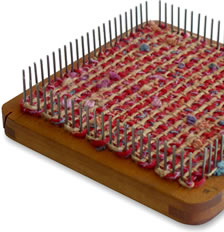
eLoomanator

weaving on little looms

Archive for March, 2008

Bolsa

Bolsa

Handwoven Magazine is running a Bag of the Month series with a free PDF download of the pattern on their website. The March/April 2008 bag is called Patchwork Peg-Loom Bag, designed by Maria Cristina Capellotto of Sao Paulo, Brazil, and I couldn’t wait to make it.

Maria calls for a 10” square loom. The closest I had without getting too big was my Hazel Rose 7” loom. In retrospect, I wouldn’t want it any larger. The finished bag is 9.5″ square. The original bag was made of sisal, but any stiff yarn would work and I had the perfect candidate in mind:

Aloo Aloo detail
Himalayan Yarn Co. TIBET 100% Aloo

Aloo (nettle) is stiff and difficult to use. It can be brittle, overtwisted, slubby, wiry and just downright contrary. It takes a firm hand to tame this stuff. I’ve tried knitting it, crocheting it, and weaving with it on a Weavette—with varying degrees of success. Basically I’m at the point of wanting to use it up and get it out of my life. This pattern is a perfect vehicle.

Aloo bag weaving

The bag calls for five woven squares, assembled just so, lined, with a braided strap. It wasn’t difficult at all. The lining is supposed to be interfaced, but I didn’t do that and probably should have. Next bag. All but one of my squares was plain weave. The flap square is a twill. I added a linen yarn to that square. My strap is composed of various linens along with one strand of aloo.

Latched loops

lining

Weaving this made me appreciate my square Hazel Rose loom all the more. The latched loop seams were fun and I hope to revisit this idea (with another yarn!) soon.

Bolsa detail

bag back

Off the Grid—a 3D Weaving Challenge

All of the projects submitted for the first contest were three-dimensional (or displayed that way) This is certainly one of the strong suits of working with small pieces that can be easily manipulated. Let’s continue that theme with larger projects.

Perhaps the first thing that you ever thought of making with your handheld loom was a blanket or afghan. Assemble lots and LOTS of pieces, add a border and there you have it. Nothing wrong with that—I’ve done it and appreciate the ones that others have made, too.

But if flat pieces were the end of it, I would have abandoned these looms long ago. I’m always on the lookout for projects that take advantage of the four finished (albeit loopy) edges, the bias stretch, the pulled warp and the small size of Weave-It or Weavette pieces.

Your challenge is to create something three-dimensional with at least twelve or more pieces. Your creation should invite views from different angles. Make us want to hug it, crush it, wear it, play with it, turn it upside-down, or display it in an unexpected way. Feel completely free to marry the weaving to another fiber technique. But if we need to see it stretched out on a flat surface to appreciate the lovely design—save it for a different contest.

Two months will give you time to call upon your muse, but don’t drag your feet on getting started because there will be fabulous prizes and you don’t want to be doing this at the last minute.

PLEASE READ THE RULES

• Project made of twelve or MORE woven squares or rectangles. (No upper limit to number of pieces.) Pieces can be all one size or any combination of sizes.

• Pieces must be woven on a handheld loom.

• You are encouraged to incorporate other craft techniques (embroidery, knitting, crochet, beading, rubber stamping, etc.), but weaving must be an integral part of the project, not just an embellishment.

• Finishing counts. Complete the project, with all seaming done, ends woven in, etc.

• This is your ORIGINAL idea. That doesn’t mean that you cannot use another idea as inspiration, but I don’t want to see your project, with a few minor variations, already on the web.

• Give your project a name.

• Project photos and written directions (or photo tutorial, if that is more appropriate) are to be submitted to me by Wednesday, May 21. (Please send your best quality photos to me in a separate email. Up to 2 or 3MB is OK.) There will be outside judges this time, although I will weigh in, too. Winners will be announced on Wednesday, May 28th.

• Entrants grant me permission to post the project and instructions on this website first. After I post it, you can publish it wherever you wish.

3D prizes

The first fabulous prize is a Weave-It Rug Loom with original box, leaflet and needle. You all know this is my favorite loom in the whole world because I can weave funky stuff on it. And they’re pretty difficult to obtain. No one makes an exact reproduction (yet) and the prices on eBay can soar. So here’s your chance.

Honorable mention fabulous prize is a 2” Weave-It loom with original box, leaflet and needle, and my favorite folding scissors, all packed in a Hello Kitty lidded tin with room inside for a skein of yarn. Pack that in your purse.

Of course the real prize is that you will be famous to a small group of readers—for a few days at least—and will have the undying admiration of small loom weavers worldwide. And the knowledge that you’ve added to the repertoire of a wonderful fiber craft.

Next week I’ll be back with more Square Deal Weave-Along. It twill be interesting, so I hope you’re all caught up.

Lovely Heart Pincushion

heart pincushion

Almost everyone’s first introduction to weaving was a potholder loom on which they wove stretchy loops to make a potholder for Mom. Most left it at that, having learned how to take skinny strings and turn them into solid fabric with simple interlacement. Today, when you mention handheld looms to the uninitiated, they often respond with a snort or a smirk. (YOU know!) They are remembering the childish play and the rather primitive-looking product and maybe mom used it for awhile and then let it go the bottom of the linen drawer. That’s too bad for them, because potholder looms are great tools, but that’s not really what this is about. It’s about exposing children to crafts, weaving in particular, at a young age.

My 17-month-old grandson’s favorite toy at Nana’s house is the basket of Weave-It samples. He flings them, rolls in them, examines them carefully, puts them in a bag and pulls them out, drops them on the dogs, picks out his favorites and carries them around all day. They end up in his pockets and hoods and under every piece of furniture. The angora ones have been felted to tiny squares from his fondling them. This kid is into textiles. I can’t wait to teach him how to weave and knit and dye and spin and felt.

I don’t know how soon I can get a loom in his hands and what kind it will be. A friend of mine has a Brio table loom for her grandsons, which she warped and they get to weave and beat in the weft. That sounds like a good start. It would take more coordination to handle a potholder loom and more than that for a Weave-It or Weavette. Please post your weaving-with-child reports in the comments because I, for one, am interested in hearing them.

All of this is leading up to our last, but NOT least, Six Square Smackdown project, woven by Princess Peach of Sydney, Australia. She was ten years old when she created her Lovely Heart Pincushion on a handmade loom, after having learned to weave at age nine. She embellished the top with a cross-stitched heart (while still under tension on the loom) and entered it in an Agricultural Show and won a prize! Princess Peach (now eleven) also knits, crochets, spins and dyes. She says “The hardest part is finding time for everything!” Well, I guess so! Somehow I think she’ll learn how to juggle it all, making time, in turn, for her favorite textile pursuits.

Homespun Pixies

Homespun Pixies

Homespun Pixies

Limiting yourselves to six squares (or pieces) for the Smackdown might have seemed very limiting. But here we have three little projects, made from a total of five squares. Barbara Giguere of Shelburne, Massachusetts (Rav handle: llamalady), knocked my socks off with her adorable dolls and the flower that accompanies them.

Directions for Homespun Dolly:

Wrap Weave-It loom, first round with a lightish color, suitable for flesh. Then continue to wrap the round perpendicular to the first with 5 rows of the same color for the head. Then switch to 5 rows of the shirt color and wrap the remainder with the skirt / pants color - wrapping the opposite two pegs from the usual way for these two colors. Leave the ends of the skirt/pants and shirt color with long enough (a yard will be plenty) tail to also use for weaving. Wrap the last round before weaving with the first light flesh color. Weave a plain over one, under one, with the flesh color up to, but not past the last wrapped row of that color. Thread the needle with the shirt color and begin weaving on the pants side (the row with the number on the side you are), and weave every row back towards the head until all rows are woven. Lastly thread your needle with the skirt/pants color and weave the remaining rows. See the picture of the woven square (it is easier to see than to explain).

weaving for doll

Weave another plain weave square using fingering weight yarn held very taut to make a slightly smaller square. (This will be the headscarf for girl doll.)

Take the first square and sew it into a tube up the back, using the tails of yarn that you have left. Gather the top of the head. Stuff the head firmly down to the neck. Gather the neck up fairly tightly. Stuff the shirt and sew from front through back along the arms (see picture). Wrapping the yarn right around at the cuff helps to define the bottom of the arm. Gather the waist slightly. Stuff the bottom. If it is to be a girl, sew flat across the bottom for her skirt. If it is to be a boy, continue by sewing up the middle to separate and define the legs.

Sew on several strands of yarn for hair and for the girl use the second, lighter weight square to tie on as a headscarf. Use the tails of yarn from the headscarf to lightly tack it to the head. Trim hair as necessary.

woven flower

Woven Flower Power

Weave two squares for the flower in any of your favorite patterns. Two different, but complimentary colors seem to work best.

Take the first square and fold two opposite sides to the middle and tack them together and to the back in the center. Then fold the other two sides of the square into the middle and tack those down…being sure not to catch the corners. Pull out each corner and turn it back a little to make a petal. Attach this to the middle of the second square. Turn each side in and tack to near the center, folding back the petals when you are done. Push a pipe cleaner up through the flower, then turn a loop and push the end back down through, twisting underneath to hold. Sew French knots or beads or whatever you like to make the center of the flower. Single crochet or wind green yarn tightly around the pipe cleaner to fake a stem (or just use a green pipe cleaner, if you prefer)

Giselle’s Gallery

Giselle, from Portland, Oregon (Rav name: parsnip), not only has some clever ideas about using small loom pieces, but she generously shares a great idea about making looms and how to keep track of square sides. I am adding her tips to my own weaving. And Giselle is a prolific weaver and designer! I hand you over to her~

Finished green bag

Box Bag

Yarn: TLC Essentials acrylic
Pattern: Plain weave
This bag uses three 4”x 4” squares and three 2.5” x 4” rectangles (rectangles can be woven using as described in Square Deal Weave-Along #8—or you can make loom to whatever size you need, using pins or finishing brads and foamcore).
Foamcore loom

Weave squares as usual. I like to put a little piece of scotch tape on the upper-left corner of each finished square, so that I don’t have to figure it out as I assemble them. (eLoomanator’s note: Brilliant! That would save so much time and many errors in layout.)

If you stack the shapes as you join them, rather than holding them flat, you get a more defined box shape (this shows up better on the green/gray stripe version). I joined them with a crocheted slip stitch. With some yarns, you can pull the skeins apart to make a thinner yarn that makes a less definite ridge.

- join top flap (2) to back square (1)
- join side rectangles (3 & 4) to back square
- join front square (5) to side rectangles (forming a box with a top flap and no bottom
- join bottom rectangle to front square, side rectangles, and back square
box bag diagram

Add handles by crocheting once around the top of the bag, to stabilize it, and then adding a chain (I used 50 stitches) and securing it to the back corners of the top. Repeat for the front corners. To add a button and loop, crochet across the front flap, then repeat, adding a short chain of about 10 stitches for the loop. Sew on button.

Here’s another version, made with green and grey yarns, and no button closure:
Green stripe bag

**********

pincushion

3-Corner Pincushion

Pattern: Plain weave
Yarn: unknown miscellaneous

This little triangular cushion-thing could be a pincushion, juggling bag, sachet, paperweight… It uses six 2” squares. Each three-square side is sewn together flat with a crocheted slip stitch. The sides are then sewn stacked, right sides facing.

- join squares 1, 2 & 3
- join squares 4, 5 & 6
- join triangles to each other, right sides together (leaving opening)
pincushion diagram

Leave the last squares unstitched so that you can turn the whole thing inside out, and then stuff it with wool or cotton stuffing for a pincushion, muslin-wrapped rice for a juggling bag, or scented filler for a sachet. Close up the last squares with a whipstitch.

**********

Blue cube Green cube

Cubes

Blue& white pattern: Plain weave
Yarn: 1st & 2nd rows unknown bulky irregular acrylic, 3rd & 4th rows lightweight cotton

Green pattern: Seven Diagonal Stripes
Yarn: unknown acrylic

This cube uses five 4” squares. Four squares are stitched together flat (using a crochet slip stitch), with the last square (the bottom) stitched together with edges held flat. (For the green one, each square was stitched together with edges stacked on top of each other. This made a more defined square shape.)

For the cube to keep its shape, you’ll need to make an open cube out of cardboard, with each side slightly less than 4” tall. This can be made out of corrugated cardboard or from a cereal box, depending on how sturdy you need it to be. The sides of the box need to be slightly shorter than the woven squares, so that the box is completely hidden when you look at the cube from the side.

**********

Foldover clutch

Foldover Clutch

Pattern: Loomette Weave #7 (see below)
Yarn: unknown wool

Join six 4” squares with a crochet slip stitch (join squares flat, not stacked), with the wrong side of the squares face down so that the ridge created by the crochet will be on the inside of the clutch.
clutch diagram

Block joined rectangle. Fold bottom of rectangle about 4” up and top of rectangle about 3.5” down (see photo – this only sounds complicated). Adjust folds so that the flap part at top falls where you want it. Slip-stitch sides of clutch.
clutch open

**********

pencil holders

Pencil Holders

Pattern:
Turquoise/blue: Loomette Weave #9 (see below)
Beige: Loomette Weave #7 (see below)
Pink: Loomette Weave #9 (see below)
Yarn: various unknown yarns

This is a good quick way to turn squares and an empty soup can into something that you can put on your desk at work and admire all day (since sometimes just sticking a woven square on the bulletin board can seem odd). It uses just two 4” squares, and they don’t even have to match. Join squares on each side, held flat, wrong sides facing up, with a crocheted slip stitch. Once they’re joined to form a sleeve, turn it inside out.

Slide the sleeve over an empty 10 oz. can (Campbell’s soup comes in this size, as well as some other random things like baby clams). Some yarns will weave a square that’s large enough to cover the can from top to bottom, so you may be able to just leave it at that. If part of the can shows, crochet one or two rows of single stitches at the top and bottom of the sleeve – this will cover the edges of the can and also draw the top and bottom in just a little, which adds a nice finish.

Or you could use a woven sleeve on an unopened can, if you wanted to your canned goods to have fancy little coats. ☺

P=Plain weave
U-Under
O=Over

Loomette Weave #7
First five rows – P. Across
6R – U3- O1- U3-O1- U3-O1- U3-O1- U3-O1- U3-O1- U3- O1- U3
7R – P2- U3-O1- U3-O1- U3-O1- U3-O1- U3-O1- U3-O1- U3- P2
8R – same as 6R
9R – same as 7R
10R – same as 6R
11R- same as 7R
Last five rows – P. Across

Loomette Weave #9
1R – P. Across
2R – U3-O1-U3-O1-U3-O1-U3-P16
3R – P14-U3-O1- U3-O1- U3-O1- U3-P2
4R- same as 2R
5R- same as 3R
6R- same as 2R
7R- same as 3R
8R- same as 2R
9R– U3-O1-U3-O1-U3-O1-U3-P16
10R- P14-U3-O1- U3-O1- U3-O1- U3-P2
11R- same as 9R
12R- same as 10R
13R- same as 9R
14R- same as 10R
15R- same as 9R
16R- P. Across