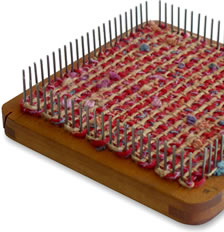
Square Deal Weave-Along #3—Fancy Weave & Basket Weave
blue—handspun wool; brown—Noro Blossom; grey—handspun wool and Brown Sheep Lamb’s Pride
The first three squares are Fancy Weave, taken from Wee Weave-It Woolies, a useful overall texture pattern that you can adapt to any size loom. It looks good in just about any yarn, but when you have one that’s too bulky or too fragile for plain weave, try this one. (See the recycled tee shirt rug, posted August 10th.) If using a second color for weaving in the last layer, you’ll see color blips on the front and colored horizontal floats on the back. (Fancy Weave is also known as Mock Seed Stitch and Loomette #1.)
U=Under
O=Over
W=plain weave
FANCY WEAVE
Wrap three continuous warp layers and measure yarn for needleweaving.
Weave as follows—
Row 1: plain weave
Row 2: *U3 (under 3 threads); O1 (over 1 thread); repeat from * across row, ending with U3.
Row 3: W2; *U3; O1; repeat from * across row to last five threads; finish with U3; W2.
Alternate Rows 2 and 3, through row 15. (Row 23 if using a 6” loom)
Row 16: plain weave
On Weave-It, Weavette and Loomette looms, always go OVER the loop of yarn that’s outside the pins. That loop isn’t mentioned in any written pattern. It’s a “given”.
The last square is Basket Weave, from “Weave-It” New-Look Afghans. It’s the same as Fancy Weave—reversed. Fancy Weave texture is created by U3, O1; Basket Weave is created by O3, U1. Viewed from the front, Fancy Weave floats are vertical and Basket Weave floats are horizontal. (Basket Weave is marginally easier to weave because Rows 2-15 are the same.)
BASKET WEAVE
Wrap three continuous warp layers and measure yarn for needleweaving.
Weave as follows—
Row 1: plain weave
Rows 2-15: *U1; O3; repeat from * to last three threads; finish with U1; O2.
Row 16: plain weave
GRAPHICS EXPLANATION & KEY: READ CAREFULLY!
Each of the squares in the 4×4 grid (not including the numbered columns at far right and far left—those are for row numbers) represents a thread crossing (intersection)—weft passing either over or under warp. Loops outside the pins are NOT shown in the grid. The needle always goes over the outside loops.
Light gray squares=weft (from the second wrap) crosses over warp on rows that you do not weave. These unnumbered rows appear as you weave the numbered rows.
White square=needle goes under a warp thread
Dark square=needle goes over a warp thread
White=UNDER
Dark=OVER


Yea! My Weave-It finally came in the mail and I got the first 2 squares done. I can’t wait to try these two. The only problem I’ve run into is that I feel like I don’t know how to finish off the ends. Any suggestions or where to find good instructions/illustrations? Thanks!
Look at the bottom of this page on the main site http://www.eloomanation.com/weaving.php and see if that helps. I do think it’s important to finish color on top of same color. That method is not totally without problems, but at least it’s less visible. I’ve also found that when you’re weaving in on the front, the back looks really nice! But it’s hard to weave in on the back. Six of one, half a dozen of the other…
Lovely - my favorite squares so far!
I’m not sure I did these correctly, but they were fast and easy!
Tag… you’re it! Check out my blog to see what to do.
Diane
Hi all - I finally got the needles and did a little weaving.
I posted picks on Flickr, so check them out.
Sheri - don’t feel bad, I am not as good at finishing as starting - getting those ends woven in necely and attaching the squares isn’t as much as the weaving for me.
I have noticed that when folks use two colors they seem to always add that second color only for the weaving round…I did that with the first square (windowpane) and it was only so-so, but when I attached it for the third round of warping (or whatever you call it) and also used it for the weaving it looked better. I am going to try that with the fancy weave, too - I am expecting a whole new look.
Barbara, it really does make a difference where you start the new color doesn’t it? We’ll play with this concept on one of the patterns. An old Loomette book shows a project that uses one pattern,four ways, each with a different combination of warp/weft colors. Hope you get the Flickr link figured out because I want to see what you’re doing!