Giselle’s Gallery
Giselle, from Portland, Oregon (Rav name: parsnip), not only has some clever ideas about using small loom pieces, but she generously shares a great idea about making looms and how to keep track of square sides. I am adding her tips to my own weaving. And Giselle is a prolific weaver and designer! I hand you over to her~
Box Bag
Yarn: TLC Essentials acrylic
Pattern: Plain weave
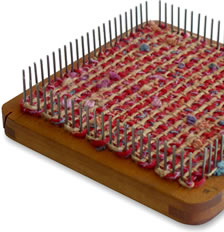
This bag uses three 4”x 4” squares and three 2.5” x 4” rectangles (rectangles can be woven using as described in Square Deal Weave-Along #8—or you can make loom to whatever size you need, using pins or finishing brads and foamcore).

Weave squares as usual. I like to put a little piece of scotch tape on the upper-left corner of each finished square, so that I don’t have to figure it out as I assemble them. (eLoomanator’s note: Brilliant! That would save so much time and many errors in layout.)
If you stack the shapes as you join them, rather than holding them flat, you get a more defined box shape (this shows up better on the green/gray stripe version). I joined them with a crocheted slip stitch. With some yarns, you can pull the skeins apart to make a thinner yarn that makes a less definite ridge.
- join top flap (2) to back square (1)
- join side rectangles (3 & 4) to back square
- join front square (5) to side rectangles (forming a box with a top flap and no bottom
- join bottom rectangle to front square, side rectangles, and back square

Add handles by crocheting once around the top of the bag, to stabilize it, and then adding a chain (I used 50 stitches) and securing it to the back corners of the top. Repeat for the front corners. To add a button and loop, crochet across the front flap, then repeat, adding a short chain of about 10 stitches for the loop. Sew on button.
Here’s another version, made with green and grey yarns, and no button closure:

**********
3-Corner Pincushion
Pattern: Plain weave
Yarn: unknown miscellaneous
This little triangular cushion-thing could be a pincushion, juggling bag, sachet, paperweight… It uses six 2” squares. Each three-square side is sewn together flat with a crocheted slip stitch. The sides are then sewn stacked, right sides facing.
- join squares 1, 2 & 3
- join squares 4, 5 & 6
- join triangles to each other, right sides together (leaving opening)

Leave the last squares unstitched so that you can turn the whole thing inside out, and then stuff it with wool or cotton stuffing for a pincushion, muslin-wrapped rice for a juggling bag, or scented filler for a sachet. Close up the last squares with a whipstitch.
**********
Cubes
Blue& white pattern: Plain weave
Yarn: 1st & 2nd rows unknown bulky irregular acrylic, 3rd & 4th rows lightweight cotton
Green pattern: Seven Diagonal Stripes
Yarn: unknown acrylic
This cube uses five 4” squares. Four squares are stitched together flat (using a crochet slip stitch), with the last square (the bottom) stitched together with edges held flat. (For the green one, each square was stitched together with edges stacked on top of each other. This made a more defined square shape.)
For the cube to keep its shape, you’ll need to make an open cube out of cardboard, with each side slightly less than 4” tall. This can be made out of corrugated cardboard or from a cereal box, depending on how sturdy you need it to be. The sides of the box need to be slightly shorter than the woven squares, so that the box is completely hidden when you look at the cube from the side.
**********
Foldover Clutch
Pattern: Loomette Weave #7 (see below)
Yarn: unknown wool
Join six 4” squares with a crochet slip stitch (join squares flat, not stacked), with the wrong side of the squares face down so that the ridge created by the crochet will be on the inside of the clutch.

Block joined rectangle. Fold bottom of rectangle about 4” up and top of rectangle about 3.5” down (see photo – this only sounds complicated). Adjust folds so that the flap part at top falls where you want it. Slip-stitch sides of clutch.

**********
Pencil Holders
Pattern:
Turquoise/blue: Loomette Weave #9 (see below)
Beige: Loomette Weave #7 (see below)
Pink: Loomette Weave #9 (see below)
Yarn: various unknown yarns
This is a good quick way to turn squares and an empty soup can into something that you can put on your desk at work and admire all day (since sometimes just sticking a woven square on the bulletin board can seem odd). It uses just two 4” squares, and they don’t even have to match. Join squares on each side, held flat, wrong sides facing up, with a crocheted slip stitch. Once they’re joined to form a sleeve, turn it inside out.
Slide the sleeve over an empty 10 oz. can (Campbell’s soup comes in this size, as well as some other random things like baby clams). Some yarns will weave a square that’s large enough to cover the can from top to bottom, so you may be able to just leave it at that. If part of the can shows, crochet one or two rows of single stitches at the top and bottom of the sleeve – this will cover the edges of the can and also draw the top and bottom in just a little, which adds a nice finish.
Or you could use a woven sleeve on an unopened can, if you wanted to your canned goods to have fancy little coats. ☺
P=Plain weave
U-Under
O=Over
Loomette Weave #7
First five rows – P. Across
6R – U3- O1- U3-O1- U3-O1- U3-O1- U3-O1- U3-O1- U3- O1- U3
7R – P2- U3-O1- U3-O1- U3-O1- U3-O1- U3-O1- U3-O1- U3- P2
8R – same as 6R
9R – same as 7R
10R – same as 6R
11R- same as 7R
Last five rows – P. Across
Loomette Weave #9
1R – P. Across
2R – U3-O1-U3-O1-U3-O1-U3-P16
3R – P14-U3-O1- U3-O1- U3-O1- U3-P2
4R- same as 2R
5R- same as 3R
6R- same as 2R
7R- same as 3R
8R- same as 2R
9R– U3-O1-U3-O1-U3-O1-U3-P16
10R- P14-U3-O1- U3-O1- U3-O1- U3-P2
11R- same as 9R
12R- same as 10R
13R- same as 9R
14R- same as 10R
15R- same as 9R
16R- P. Across


Wow! You were right about her creative ideas. Thanks for sharing.
Hi! This looks so nice! Thanks!